
Well, looks like I forgot to add the actual picture of Heather’s flower Lego to the post, so here it is:
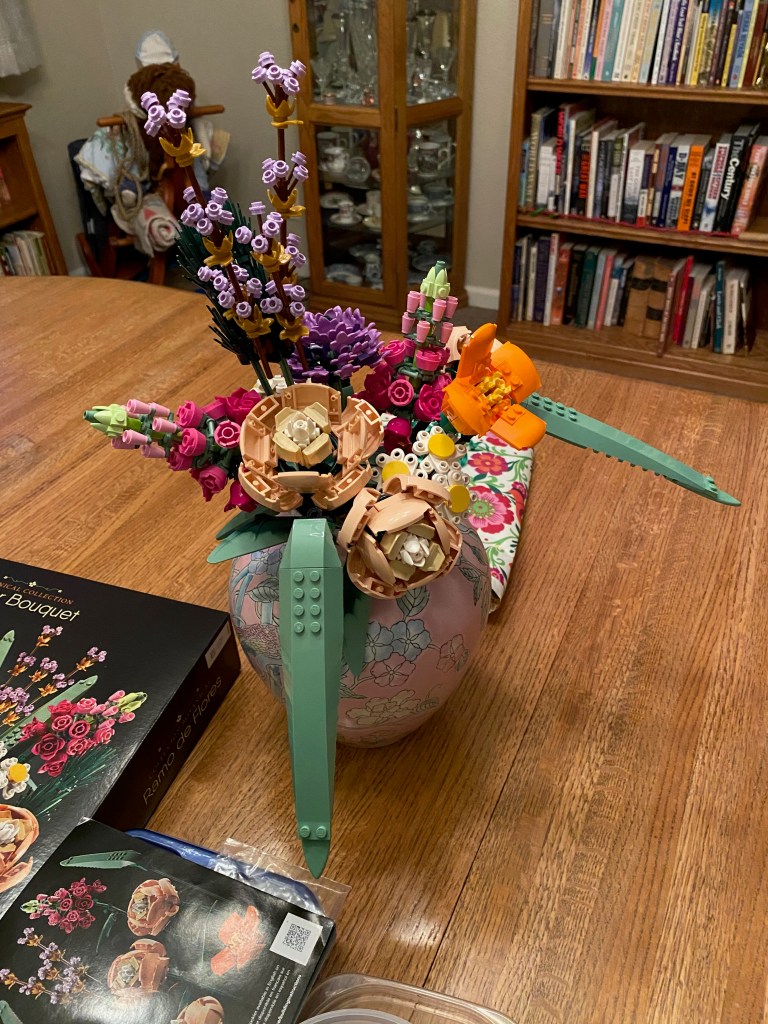
Well, looks like I forgot to add the actual picture of Heather’s flower Lego to the post, so here it is:
First the important stuff: Sunset: 5:09 p.m. and Sunrise 7:15 a.m.
Now what I’m watching for is when the sunrise is before 7:00 a.m. I’m the kind of person who sleeps when it’s dark and am awake when it’s light. In the summer I don’t sleep as much as I do in the winter. It’s just the way my brain is wired. An earlier sunrise just means that I’ll be getting out of bed earlier and have a chance of being dressed and ready to go before 10:00 a.m.
I’m retired, I don’t do rushed mornings to get to work on time.
Wonder how many people do this: I was drinking tea and watching the birds with my cats when it started snowing. After telling Heather it was snowing, I got out my cell phone and checked the weather app and sure enough it said it was snowing. The cat’s didn’t venture an opinion. This is one of those times when I have a bit of an out of body experience. Part of my brain sees snow, part wants confirmation and the other part is asking, “You can see snow, why are you checking the weather?”
I’ve also been known to look at a clock and then take out my cell phone to make sure the clock is right. How did we ever get along without our cell phones. These days it does everything, it’s a calculator, oven timer, appointment reminder, email, text, phone, camera, and deck of cards all in one.
I used to play solitaire with real cards, but now I do that on my phone. It’s nice since the app deals the cards, suggests moves, records wins, but it does have a few annoying ads (nothing is free). About the only thing you can’t really do with a cell phone solitaire is cheat. Really hard to cheat at solitaire on a phone app.
Which reminds me of the line from Janis Ian’s song, At Seventeen, that says, “To cheat ourselves at solitaire.” Which has nothing to do with this post, but it came to mind and I thought I’d mention it. Actually that song likely deserves its own post.
In other news Heather and I finished assembling her birthday present of a Lego flower bouquet. It had about 800 pieces and took us about four hours to complete. Here’s a picture:
Well, that’s about it for this week except to mention that this week we’re having our standard pepperoni and olive pizza. I did have a cauliflower curst pizza in the freezer, but with the snow and a predicted low of nine degrees tomorrow morning, pepperoni seemed to be a better choice. The timer just went, till next week …
This week I went with Heather to her portrait painting class. I don’t paint. I was the model. Yup, I sat in a chair while 12 people worked on making a portrait of my face. Some worked in oils, some in pencil, some water color. It was an interesting experience sitting for a couple of hours. There were breaks and I looked at the art work. Some portraits actually look like me. I learned a lot about the artistic process and here is what I know about artists:
What do artists draw at night? The curtains.
What’s the best way to get an artist of your doorstep? Just pay for the pizza.
Why did the artist run out of gas for her van? She didn’t have the Monet to buy Degas to make the Van Gogh.
I know an artist so good that he can always draw a crowd.
I was at the shoe store and found out that artists only buy Sketchers.
I saw this guy drawing a picture of a Ford F-150. He’s a real pickup artist.
How many surrealist painters does it take to change a light bulb? Just one, with a giraffe.
I meet a sculpture who’s doing very well – just last year she made six figures.
Why do people paint Easter eggs? Well, it’s easier than wallpapering them.
There was this artist who always took things too far – he didn’t know where to draw the line.
Why aren’t mathematicians considered artists? Well, there art is derivative.
I went to an exhibit of still-life paintings. It wasn’t moving.
Why didn’t the martial artist not pass the math test? She was kung-fused.
The local art guild just bought a ship – it’s an oil liner.
The most commonly used phrase by working artists: “Do you want fries with that?”
I once asked a tattoo artist to cover my arms with flames. She refused because she didn’t have a firearms permit.
There was an art contest at the museum. It ended in a draw.
They arrested an artist last week. He claims he was framed.
I started writing a joke about a broken pencil, but it was pointless.
The artist said he was thinking of quitting, but he’s in the home sketch.
There was no pizza this week, so the title is incorrect, but thinking of a new title is just too much work. Actually we’re having pork chops, so this could be, “As the Pork Chop Fries.” And it’s not Sunday (I had to check that just to make sure). For those of you who are following along, sunset was 5:08 pm today.
The reason for no pizza is that it’s our birthday weekend. Heather and I have birthdays exactly one week apart so we often have a special meal or party on the weekend between our birthdays. This year we did both. Saturday night we went to a local steak house for an expensive evening of recreational overeating. Then on Sunday we invited the family over for a birthday dinner. This one we just catered from a local restaurant so we wouldn’t have to worry about cooking.
I think I overate on Sunday too. I figure I’ll need about a three month diet to undo the damage from a steak dinner followed by Italian dinner the next night. It could be the end of March before I stop feeling overstuffed.
Anyway, that’s why we didn’t have pizza this weekend.
Both meals were good, but marked by slow service. Not horribly slow, but slower than I wanted. We arrived at the steak house at 5:30, but didn’t leave until about 8:00. In the UK or Europe that might be normal, but I’m sure we could have enjoyed the filet mignon, salad and desert in one and a half hours and been very satisfied with our meal experience. I don’t know if the kitchen was slow or whether the waiter was slow or just had too many tables to look after. We’re not allowed to call them waiter or waitress anymore so I should say server. There are times when I wonder when we’ll be calling them “Food Facilitator” or “Meal Experience Manager.” Perhaps table runners (formerly busboys) will be called, tableware renewal engineers.
The meal on Sunday was only 15 minutes late so I guess that’s not bad. The food was still hot when they put it in my car. The only real complaint was that the salad did seem much smaller than expected. That, and I was expecting the chicken alfredo to have the sauce already poured over the chicken and not in a separate foil pan.
There is so much more I could talk about, but Heather got a special flower Lego set and I’ve promised to help build it.
Later …


