My dear old daddy (and he liked being called ‘my dear old daddy’) use to say:
“If you have to swallow a toad, better do it now as it can only get bigger.”
More wisdom next week,
Andrew
My dear old daddy (and he liked being called ‘my dear old daddy’) use to say:
“If you have to swallow a toad, better do it now as it can only get bigger.”
More wisdom next week,
Andrew
I haven’t been in the workshop much. Instead I’ve been digging in the garden. We have this area where we’ve tried have a vegetable garden, but it’s never really worked out. Between water cuts, bugs, diseases and local animals we rarely get anything we can actually eat.
A couple of weeks ago Heather and I went to see Filoli. This is an old estate south of San Francisco with wonderful gardens. It’s a favorite place of ours. One of the gardens they have is called, “The cutting garden,” which supplies cut flowers for the estate. That’s when the idea hit me, instead of being frustrated trying to do a vegetable garden, why not a cutting garden?
We love flowers and they do well in our yard so with the Filoli inspiration we’ve started to convert the little veggie plot. Here’s what it looks like at the moment:
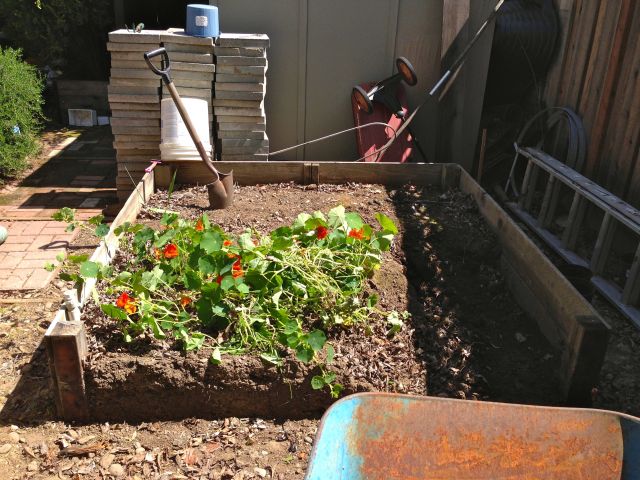
The future cutting garden.
The plan is to rebuild the planter into a number of smaller boxes, improve the drip irrigation and enclose the whole thing in a wire cage to keep the local squirrels, raccoons and possums at bay. This last weekend I dug out much of the poor soil that was here and started cleaning up the area. Heather started some seedlings that we’ll transplant here in a few weeks.
More on this project as the weeks go by.
If you need me – I’ll be out back,
Andrew
Last week I wrote about the one last poem I needed to write. It’s done. Here’s what happened:
I had fully intended to rewrite it as a little playlet with two characters, so I opened a new editing window and copied the poem over. Then I gathered my courage and sat down to write.
And I stared at the poem.
Then stared some more.
I thought how to expand it, where to put the dialog, where to add the explanation on what is going on and from what point of view to tell the story.
Then I saw a line in the poem that wasn’t needed so I deleted it. Then I saw another, and another. I deleted about half a page of the poem. Then I saw a word that wasn’t right and I found another word. There were redundant words so I trimmed them. Near the middle I found a confusing line. I made a small edit to clarify.
I pruned, changed and refined the words and abandoned the play. Then I realized it was done.
It’s been a full year since I first wrote that poem and now my poetry collection’s words sit complete in my computer. Now the problem is how to release it from my desk and into the world.
I’ll admit that is more than a bit scary. Some of the poems in the collection are personal and touch on the raw edges of my emotions. In some ways I am still unsure about letting anyone read it.
But, I know that it must be done. I won’t make any money with this. At best I hope to earn my costs back. Still, it is my hope that these words of mine will find their way in to the hands and hearts of a few who might find the words beneficial.
Now it is off to the Amazon website to figure out formatting requirements.
No great insights this week, just that space between the hammer falls of creativity.
Till next week,
Andrew
Just around dinner time I said, “I feel like a pizza.”
“Funny you don’t look like a pizza.” replied my father.
More wisdom next week,
Andrew


